
Why Is My Senior Dog Anxious?
The Complete Guide to Anxiety & Dementia Spiral“As a veterinarian and senior pet owner, I have spent 20 years watching the bond between humans and their dogs evolve. There was nothing more heartbreaking than watching my own dog, Bailey, grow deeply confused and anxious as she got older and I completely missed the cause until it was too late. So, now I’m on a mission to bridge the gap between the science and caring for not just a patient, but for a member of family.”
I thought Bailey was just “getting old” or “slowing down.” It turns out, this was her first sign of congnitive decline. Learn from my mistakes and my experience because what looks like simple aging is often something we can address if caught early.
Quick Fact: 1 in 3 dogs over age 8 shows signs of Cognitive Dysfunction, but less than 2% are officially diagnosed. Here is how to tell if your dog is in that gap.
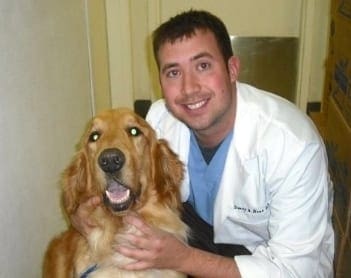
Dr. Stacey Bone & Bailey
Chief Veterinarian
Understanding Senior Dog Anxiety (It’s Not Just ‘Aging’)
Before we start, you may not even recognize your dog’s issue as anxiety. I wish it was a simple thing, but the reality is that anxiety can present in a number of different ways. If you are experiencing any of these things, you are not alone. Anxiety in senior pets can be unbelievably frustrating, and you are probably asking yourself, “Why is this happening?”

Strange reactions to familiar places
Does your dog suddenly react differently at daycare? The dog park? A family member’s house?

Dog no longer sleeps at night
Are you seeing more pacing, whining, and general confusion at night time that is not typical behavior?
New Sudden Anxieties
Has your dog suddenly developed rain/wind storm, separation, or travel anxiety that they haven’t had before?
Understanding Senior Dog Anxiety (It’s Not Just “Aging”)
Before we start, you may not even recognize your dog’s issue as anxiety. I wish it was a simple thing, but the reality is that anxiety can present in a number of different ways.
Let’s lay out some of the most common ones:
-
- Abnormal reaction to unfamiliar OR familiar places:
Does your dog suddenly react differently at daycare? The dog park? A family member’s house? - Abnormal reaction to unfamiliar OR familiar people:
Does your dog react differently to meeting people? Acting shy, afraid, or even aggressive? Do they seem like they no longer recognize people that they used to or seem scared around people they used to be comfortable with? - New “common” Anxieties:
Has your dog suddenly developed rain/wind storm, separation, or travel anxiety that they haven’t had before? - Nighttime anxieties:
Instead of sleeping, do you find your dog has difficulty falling asleep? Pant, pace the floor, whining or vocalize during the night time? - Separation from Family:
Has your dog suddenly become less social? Do they shy away from company or groups of people in your home? Are they more withdrawn?
- Abnormal reaction to unfamiliar OR familiar places:
If you are experiencing any of these things, you are not alone. Anxiety in senior pets can be an unbelievably frustrating thing and you are probably asking yourself, “Why is this happening?”
As veterinarians, here is what we actually know. Anxiety that develops in a senior pet (think 7+ years of age) is almost always secondary to something. To put it scientifically, it is generally a consequence of biological changes to the brain keeping it from being able to process normal things correctly.
As veterinarians, here is what we actually know. Anxiety that develops in a senior pet (think 7+ years of age) is almost always secondary to something. Scientifically speaking, it is generally a consequence of biological changes to the brain that prevent it from processing normal stimuli correctly.
CDS: What Is Canine Cognitive Dysfunction
(The “Biological Mirror”)
What Bailey was experiencing—and what your dog is likely experiencing—is the canine version of Alzheimer’s. In the medical world, we call this the Biological Mirror. The same plaques that cloud a human mind are also “rusting” your dog’s neural pathways. In dogs, this is known as Cognitive Dysfunction Syndrome (CDS), Doggy Dementia, or Cognitive Decline.
Anxiety is the hallmark CDS, along with other signs known as DISHAAL:
Disorientation
Interactions
Sleep Changes
House Soiling
Activity Changes
Anxiety
Learning & Memory
As I finish up this section, I think it is important again to note that CDS is a diagnosis of exclusion. You are probably thinking that many of these symptoms could also be explained by other things, and you are absolutely correct. A common cause is pain, like what you might see with a dog who has arthritis, another very common disease in senior pets. For instance, it can be common for dogs with severe hip arthritis to defecate in the house because it hurts for them to squat. Since it hurts, they might not poop outside and can constipate themselves until they can’t hold it any longer. Again, this is why it is paramount to bring up any new sign with your veterinarian.
Stop waiting for it to just “get better” on its own.
Use the DISHAAL checklist to track the changes you are seeing and get to your vet right away. By treating this early, We can protect what’s left of their precious brain.
Anxiety and Chronic Stress
I think anyone with anxiety will tell you it is stressful, and hopefully, I have convinced you that multiple levels of chronic stress are occurring in dogs with CDS. However, it goes beyond just the anxiety and fear that you are seeing; there are deeper processes that are occurring that are causing a pretty vicious feedback loop. Anxiety and fear cause the release of cortisol and chronic cortisol is actually directly toxic to the brain. So not only is the anxiety causing outward signs, but it is also directly contributing to further damage in the brain. Many owners ask if they should “just live with” the pacing or the shaking. My answer is always no. Because we now know that anxiety is a biological driver of the disease, treating your dog’s fear isn’t just about their comfort; it is about slowing the physical destruction of their brain cells.
At-Home Observations
Keep track of what is happening for the next week:
- When does anxiety happen (time of day, situation)?
- Does your dog seem lost in familiar places?
- Does your dog recognize familiar people and routines?
- Any new accidents happening in the house?
- Is sleep worse at night and better when everyone’s awake?
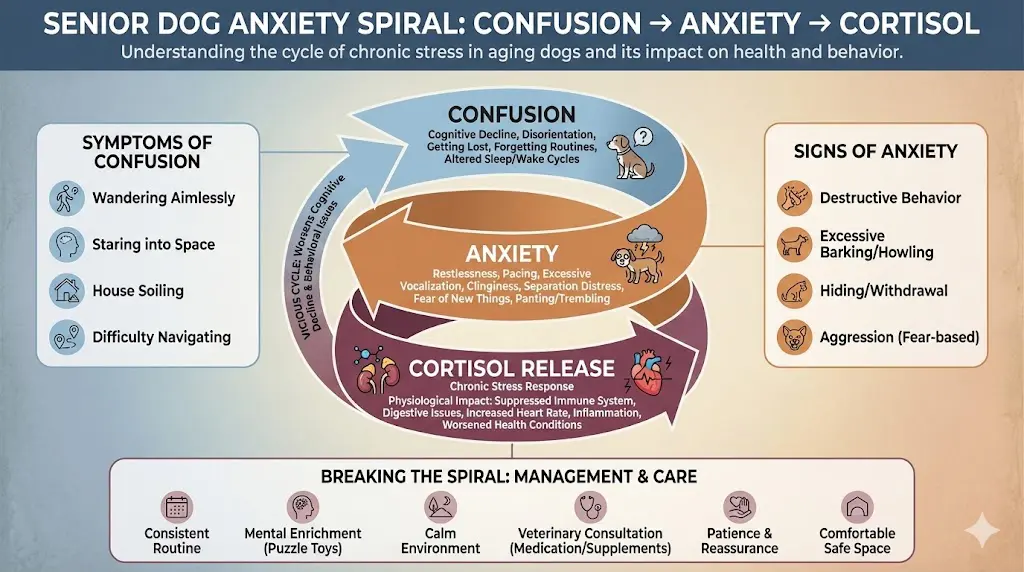
The Feedback Spiral
As a dog’s cognitive ability declines, they lose their ‘internal anchor.’ Simple events like a door closing or a shadow moving can trigger a cascade of fear.
This isn’t just behavioral—it’s physiological. The brain’s stress response system becomes hyper-sensitive, creating a loop where confusion breeds anxiety, and anxiety further inhibits clear thinking.
The Anxiety–Dementia Spiral: How They Feed Each Other
We often think of anxiety as just a symptom, but in senior dogs, it actually becomes the driver of the disease. This creates a feedback loop.
First, I need to explain the concept of habituation. Habituation is a mechanism in dogs and cats where they can filter sounds over time as they become used to them. For example, they might initially bark at the television being on, but over time, they can essentially filter it out.
In dogs with CDS those filters are gone. Any new sound at all they perceive as dangerous and life-threatening. This leads to a state of hyper-vigilance and ongoing stress.
” I saw this clearly with Bailey. She went her whole life not having storm anxiety. Then, at 13, she became petrified of storms, often shaking so violently that we couldn’t sleep. We eventually would take her into our basement so that she hopefully wouldn’t hear thunder. That wasn’t just “fear”—that was her brain losing the ability to filter out the noise. “
About the Cortisol Loop
I think anyone with anxiety can tell you that it is stressful, and hopefully, I have convinced you that multiple levels of chronic stress are now occurring in dogs with CDS. However, it goes beyond just the anxiety and the fear that you are seeing; there are deeper processes that are occurring that are causing a pretty vicious feedback loop in your pet.
Anxiety and fear cause the release of cortisol and chronic cortisol is actually directly toxic to the brain. So not only is the anxiety causing outward signs, but it is also directly contributing to further damage in the brain.
Their Broken “GPS”
As I mentioned before, dogs with CDS also have brain atrophy. The first area of the brain that is affected is an area called the Hippocampus. The hippocampus is the brain’s GPS and helps to create new memories. When it atrophies, it causes disorientation. We talk about dogs getting trapped in corners and being unable to get out, or trying to exit a door by going to the side with the hinges.
It also changes how they interact with us. When the plaques in the brain begin to build up, this can impair social recognition, and dogs may begin to perceive family members as strangers or withdraw from the pack.
” With Bailey, this withdrawal was subtle at first. She began going into our spare bedroom to sleep on the pillows when, previously, she had almost always hung out with us in the family room while we watched TV at night. I didn’t realize at the time that her “GPS” was failing her—she was retreating because the family room had become too overwhelming. “
Is It Anxiety, Dementia, or Pain?
Because our dogs cannot speak, it is often difficult to tell where the behavior is coming from.
It is important to note that CDS is a diagnosis of exclusion. You are probably thinking that many of these symptoms could also be explained by other things, and you would be correct. A more common cause is pain, like what you might see with a dog who has arthritis, another very common disease in senior pets.
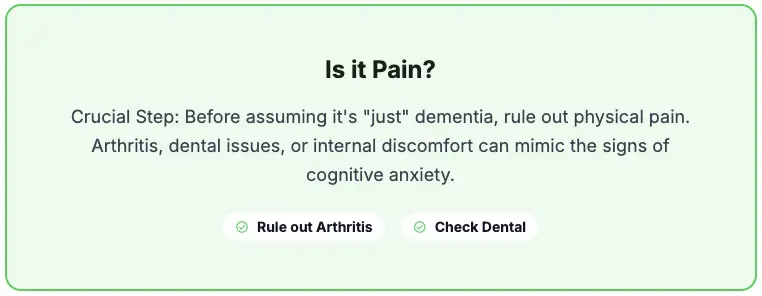
For instance, it is common for dogs with severe hip arthritis to defecate (poop) in the house because it hurts for them to squat. Since it hurts them so much, they might not poop when they are outside and can get constipated until they just can’t hold it any longer. Again, this is why it is important to bring up any new signs with your veterinarian.
Breaking the Spiral: What You Can Do at Home
While dementia cannot be cured, anxiety can be managed to slow progression and improve quality of life.
Manage the Light
If your dog suffers from ‘sundowners’ or spatial anxiety, darkness is their enemy. Keep nightlights on in hallways to help with spatial awareness.
Soothing Bedtime Routine
Consistency is the key for a confused brain. Try to keep the order of events (bathroom, water, bedtime) exactly the same. Maintain a consistent bedtime routine.
Reduce Noise
Their ‘filters’ are failing or now gone, normal house sounds can be terrifying. White noise machines or soft classical music can help reduce noise & create a calming environment.
Here are Some Long-Term Strategies
- Enrichment: Get Pet puzzle toys and scent games
- Environment: Non-slip surfaces for confidence
- Supplements & Nutrition: Omega-3 for wellness
See Also
- Environment: Safe Home Floor Plans For Dogs
- Supplements : In Depth Supplements Article (Coming Soon)
Key Takeaways: A Veterinarian’s Perspective
For decades, we have viewed “old dog anxiety” and “dementia” as two separate problems. We treated the anxiety with drugs or sedatives and dementia with supplements, completely failing to see that they are actually two sides of the same biological coin. I am speaking to you as both a veterinarian and someone who had to eventually euthanize their beloved companion of 16 years because of Cognitive Dysfunction Syndrome.
The Physical Change :
Your dog’s brain is literally ‘rusting.’ The brain undergoes physical degeneration. Amyloid plaques interfere with neuron communication, while brain atrophy and oxidative damage further impair function.
The Mental Fallout :
When that GPS fails, your dog gets lost in their own living room. Disorientation triggers stress hormone release.
The Vicious Cycle :
Chronic cortisol is toxic. It acts like acid burning the brain. Chronic cortisol accelerates neurological damage.
You didn’t fail your dog by missing early signs. I’m a vet, and I missed them too. Now that we understand about the biological mirror, we have the tools so we can fight back!