
Environmental Health
Home Modifications for Dogs With Anxiety and Cognitive Dysfunction
By Dr. Bone • 20 years of clinical experience
Imagine you wake up in a hotel room you have never been in, in total darkness. For a few seconds you don’t know where the lights or bathroom are, and you panic. That is what our senior pets with Canine Cognitive Dysfunction feel almost all the time, and we must realize that the home that they have lived in for many years may no longer feel familiar and may contribute to furthering the anxiety and stress we have talked about. What we are doing is turning the house into a sanctuary, a safe space that your senior dog can still thrive in.
Recognizing the Signs
Before we modify, lets pause and understand how cognitive decline manifests.
Over the last 20 years I have learned that a critical piece of managing anxiety and cognitive dysfunction was left out: Environmental Modification. Creating a safe home space based on the symptoms that a dog is exhibiting is a crucial piece of managing anxiety to cope with all the issues CDS will bring. But before I outline specifically how you can adapt your home for your senior pet, let’s review the syndromes/symptoms you are dealing with that modifying the environment can help with.
Panting, Pacing & Disorientation
The ‘GPS’ on many of our senior pets is not functioning the way it should.
Repetitive movement and inability to settle, often triggered by confusion or discomfort with the floor texture.
They can forget how to navigate around the house, get trapped in corners, have difficulty figuring out how to get through doorways, and can have contributing vision issues like cataracts or lenticular sclerosis.
Anxiety
Heightened fear of previously normal objects, sounds, or spatial layouts in the home environment.
A culmination of multiple things — including refusal to enter rooms, nighttime waking, vocalizing and pacing, and reluctance to go outside.
Many senior dogs also have arthritis, making walking on smooth, tile, or hardwood floors difficult — which can reinforce anxiety about entering rooms or crossing thresholds.
Sensory Overload
Difficulty processing multiple stimuli—loud TVs, bright flashing lights, or crowded walkways.
Because your dog’s brain is not operating at full capacity, it can lead to overreacting to things they may not have ever paid attention to before — especially shadows and reflections. It can be difficult for your dog to understand that these are not threats or uninvited guests.
Sundowning
Increased confusion and agitation that begins late in the afternoon as natural light fades.
Panting and pacing that particularly occurs when ambient light outside starts to dim. One strategy is to pre-empt sundowning by scheduling lights to turn on before outside lighting starts to fade.
When Should You Start Modifying?
Environmental modification isn’t a one-and-done project. It’s an adaptive process that grows alongside your dog’s needs.
Start now if: You are worried about them injuring themselves, or if you notice their sensory world is starting to decline. Early intervention prevents the “panic cycles” that can accelerate cognitive decline.
⚠️ Note of Caution
Environmental modifications are not a replacement for veterinary care and medication. If your dog is experiencing significant cognitive dysfunction, anxiety, or behavioral changes, consult with your veterinarian. Many of these symptoms can be managed with a combination of environmental changes, medication, and behavioral support.
The first question you are probably asking is “When should I do this?”
There is not just one right answer, but what I usually tell pet owners is to consider making environmental changes to the house when they are worried about their dog hurting themselves. This can be something as simple as getting lost in the backyard or something as serious as potentially falling down the stairs.
Secondarily, if your dog is having sensory decline, vision issues, or significant panting and pacing or night anxiety, then I would recommend starting to adapt to what is happening. And, ultimately, you likely won’t be doing it all at once…but adapting the environment to new issues that develop over time.
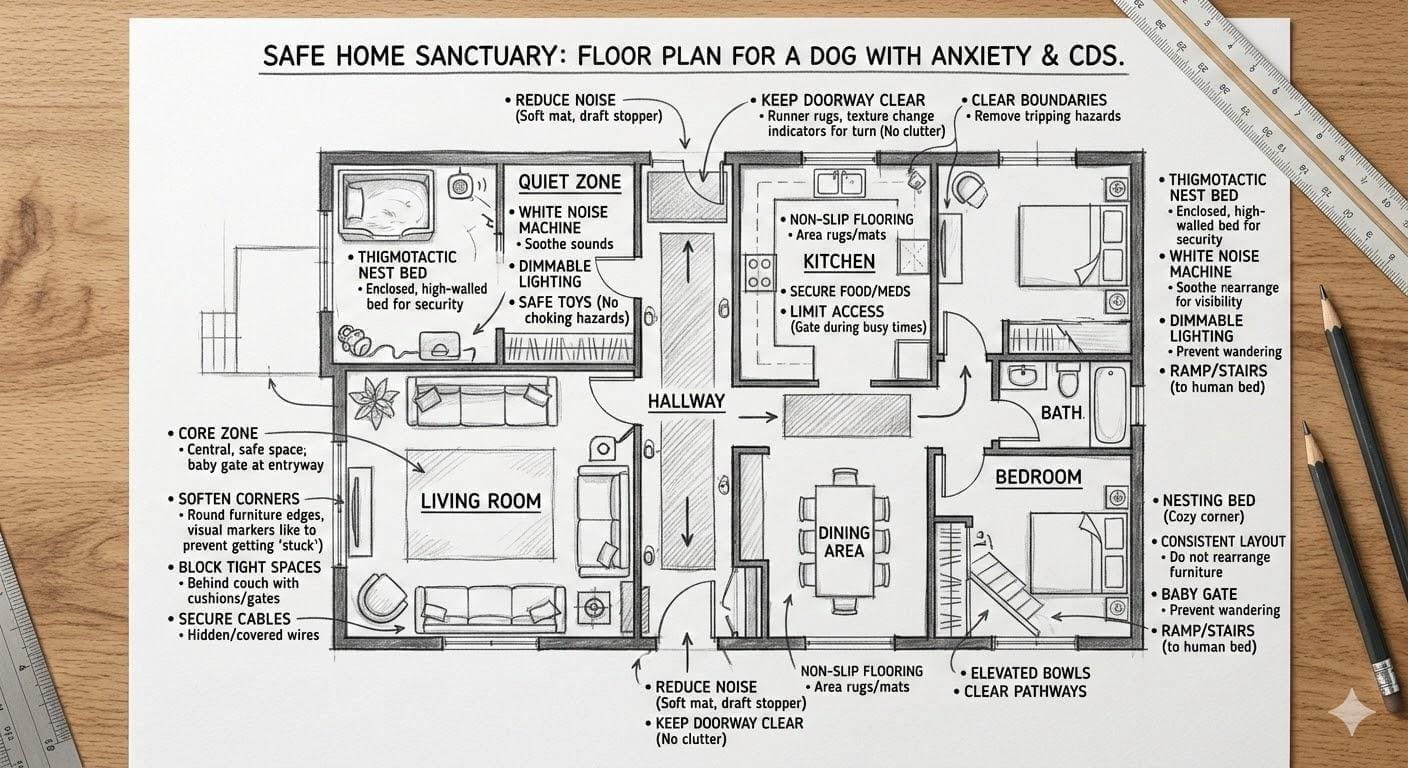
Now we can talk about core strategies to help modify your home. My intention is for you to adapt these strategies to your specific living situation; maybe some of these won’t work for a smaller apartment vs. a 2-3 story home and there might be things that are completely out of your control.
1. Defining Core Zones
🧠 Restricted Comfort
For almost all of our pets, I recommend defining core zones of the house.
For almost all of our pets, in any living environment, they have their favorite places. You can think of these immediately. Where do they spend their time? What are their habits? At what times of the day do they frequent them?
Your job is to map this out and then try to block off any other locations that are less frequented. For example, limit it to the living room, kitchen, and bedroom if that is where your dog sleeps. Maybe just the living room and the kitchen if your dog sleeps in a crate.
I would recommend putting a physical barrier up—like a baby gate. Vendors make some really nice gates now that will cover larger openings as well. I have used them and really found them to be helpful.
Keep it as restricted as possible while still allowing them to feel like part of the family. Why? Decision paralysis is a real thing for dogs with CCD—too many choices of where to go can lead to cognitive dysfunction and anxiety..
📄 Managing Barrier Frustration
Solid gates can cause panic if a dog feels disconnected from you. Use mesh or see-through gates so they can still see their owner, which is vital for dogs suffering from co-morbid separation anxiety.
Note of Caution – Barrier Frustration
While it is extremely important to limit access to lesser-used areas of the house and to stick to the “core zone” concept, we also have to be aware of abrupt changes to the environment. One way to mitigate this is to maintain the ability for your dog to see you; consider mesh baby gates or those that your dog can still see through. Make sure that you don’t block off areas that you personally spend a lot of time in if your dog is very attached to you. Separation anxiety can also be a serious thing. If this is unavoidable, then consider the same as above; see-through mesh gates or “wrought-iron-style” baby gates.
⚠️ The Golden Rule of Predictability
Avoid moving furniture or changing the layout of core zones. Predictability is the greatest gift for a brain that’s struggling with spatial orientation.
Comprehensive Home Modification List
Lighting & Sundowning
This is one that a lot of people don’t think about. We, unfortunately, don’t have much research on the veterinary side but can draw some parallels…even if it is more geared towards “better being safe than sorry.” In general, I highly recommend that you employ pathway lighting for senior pets for a myriad of reasons.
01: Use warm lights, low to the ground like night lights to create a soft, inviting atmosphere for pets.
02: Focus lighting specifically on thresholds and stairs to prevent stumbling and injury.
03: Pre-empt” the sundowning by scheduling lights to turn on before the outside lighting starts to dim.
Injury Risk Reduction
Ok, this can be a really important (and complicated) section. I’d recommend thinking from your dog’s point of view. Walk the routes that your dog might be pacing at night. Get eye level to where they are and look at this from a different perspective. I know it seems weird, but just like with kids, the things that can be dangerous to them are different than what we might see. Let me hit the high points of some of the most important things:
-
🟫
Corner Softening
Look for corners that are open; consider putting something there to block them so your dog cannot get trapped. Plants or furniture can be a good idea to achieve this.
-
🪑
Block Tight Spaces
Anywhere your dog might be able to get into but would really struggle to get out of. The number one example is behind the couch. My dog Bailey would get trapped behind our couch often because she would wander back there, but couldn’t quite figure out how to turn herself around and get back out.
-
⬜️
Removable, High Contrast Tape
This can help to delineate doorways easily and act as a sort of road sign to indicate where the door frame is, especially at night.
-
🟫
Eliminating Narrow Gaps
Any “traps” that your dog might be able to enter but would not easily be able to exit. It’s important to try to identify these traps around the house.
-
🛡
Safe Zones From Other Pets
If you have multiple pets, especially a younger and more rambunctious dog (or toddler), it’s generally a good idea to give your senior dog a safe spot to sleep/rest in that is safe. I tend to recommend a kennel or high-sided pet bed.
Sound/Noise Management
One interesting thing that happens to many dogs as they age and deal with cognitive decline is the loss of the ability to handle excessive noise. This can manifest in a variety of ways, including new noise anxiety (doorbells, storms, etc.), fear of “normal” household noises (like smoke alarms), and sensory overload from everyday activity.
While it’s next to impossible to eliminate noise from the house, consider mechanisms to dampen the sounds, like rugs, carpets, or even white noise machines. Sudden noises cause prolonged disorientation — mask triggers with a consistent sound environment.
“Bailey’s storm anxiety was intense. We used classical music and white noise to create a ‘sound blanket’ that masks thunder. She would often require us to turn on music or televisions to drown out what we could.”
💡
PRO-TIP: TV audio can provide helpful familiar background noise at home.
The Nest Concept
I wanted to address this section specifically. If you’re like me, your dogs sleep in the bed with you…or at least in the bedroom. This can cause extra strain with a dog dealing with CDS and anxiety-heavy episodes, as it can lead to disturbed sleep for all involved.
It can be very beneficial to create a “nest” of sorts. When Bailey was dealing with her more severe CDS, she became thigmotactic — a fancy word for wanting to feel more safe, secure, and having something up against her at almost all times.
“The high-walled bed was a godsend for Bailey. We ended up getting a special dog bed with high walls that she would curl up in every night on our bed. This was a godsend. I highly encourage you to look at something similar, and if your dog just sleeps on the floor of the bedroom, consider doing something similar on the floor.”
You should also consider some sort of safe stairway system in case your dog needs to get down from the bed in the middle of the night.
Adaptations for Renters
Understanding that many of you don’t own your home, we can adapt this strategy for rentals, where you might not be able to put holes in walls or mount things. Thankfully, most of the items mentioned above are removable, but you can always use command strips or other temporary solutions.
I strongly recommend using our PawFriction Kit as it’s bothsafe for floors and furniture, and can help in hallways and stairs, where you likely cannot make changes. Interlocking foam floor tiles (secured with command strips) provide excellent traction, are 100% removable, and protect original flooring.
Affordable
Effective
It’s heartbreaking to watch a dog who once navigated the world with total confidence suddenly become a stranger in their own home. It’s easy to feel helpless when your dog’s mind starts to fail. But modifying your home is an act of advocacy. We aren’t just dog-proofing a house; we are building a sanctuary where they can finally stop “searching” and start resting. We are giving them back the one thing anxiety takes away: the feeling of being safe at home.
I know that all of this can be complex and maybe not even possible where you live, but I encourage you to do any of the above to help with the anxiety that comes from a dog having cognitive dysfunction. Even little changes can make a huge difference.
It’s your way of telling your senior pet, “I see you, and I’ve got you.”
Pawtology Dr. Stacey Bone